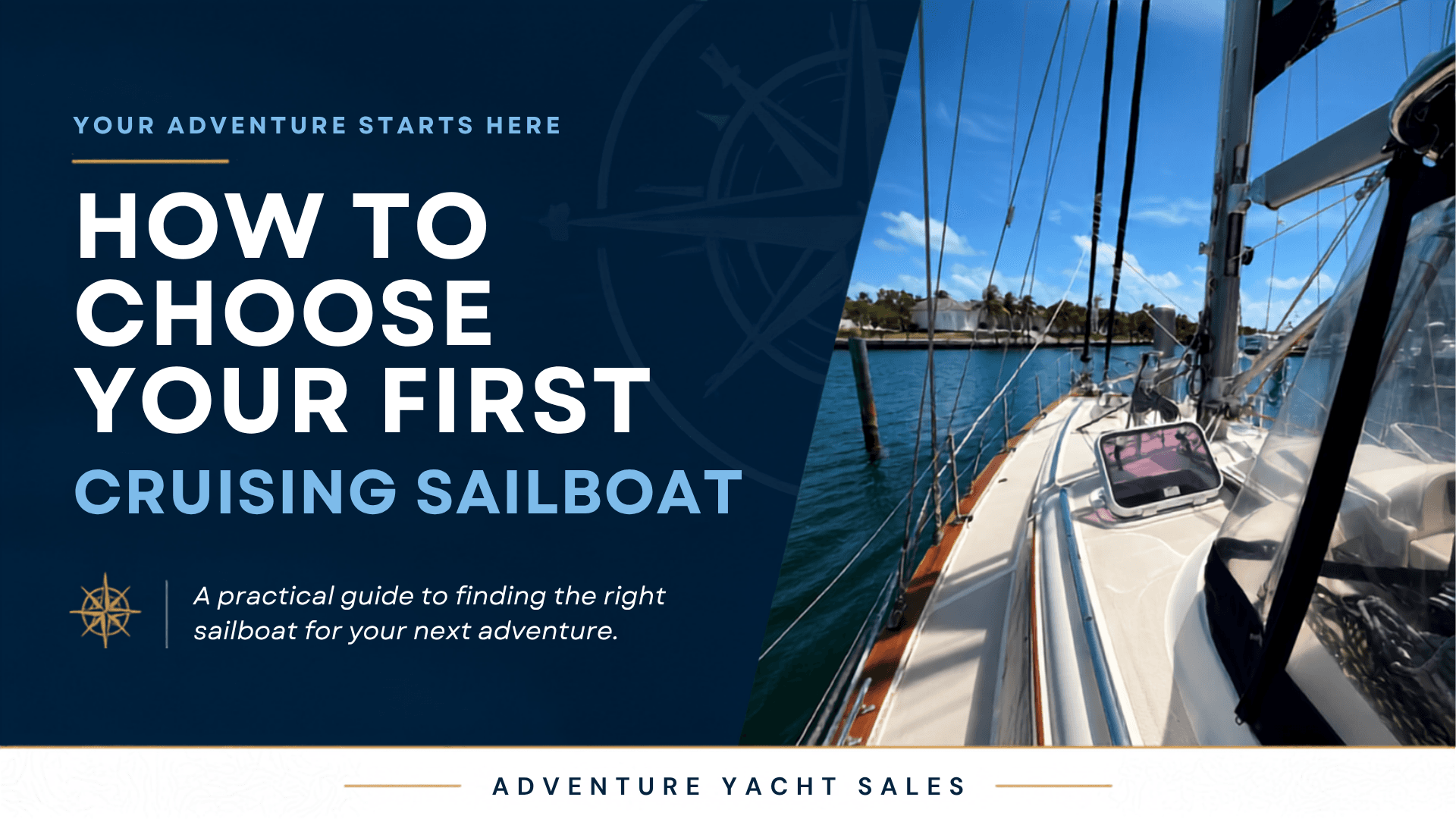
How to Choose Your First Cruising Sailboat
A practical guide to choosing the right cruising sailboat based on your experience, cruising plans, budget, comfort, and long-term goals.
Buying your first cruising sailboat is exciting—but it can also feel overwhelming.
Walk through a marina and you will see boats of every size, age, design, and price. Some are built for speed. Others are designed for comfort. Some are excellent coastal cruisers, while others are designed to cross oceans.
So, how do you know which one is right for you?
The best first cruising sailboat is not necessarily the biggest, newest, or most expensive boat you can afford. It is the boat that matches how you actually plan to use it, your experience level, your budget, and the type of cruising you want to do.
Before you fall in love with a particular boat, take some time to understand what you really need.
Start With Your Cruising Goals
The first question to ask is simple:
Where do you want to go?
Your answer will influence almost every other decision.
Someone planning weekend trips along the Intracoastal Waterway has very different requirements from someone preparing for an offshore passage or an eventual ocean crossing.
Think about how you realistically expect to use the boat during the first few years.
Coastal Cruising
If your goal is weekend or extended coastal cruising, you may not need a boat designed specifically for offshore passagemaking.
A coastal cruiser may prioritize:
Comfortable accommodations
Easy handling
Good storage
Moderate draft
Efficient systems
Comfortable cockpit space
Reasonable maintenance costs
A boat that is simple and easy to handle can be a great choice when you are still building sailing experience.
Extended or Offshore Cruising
If your plans include longer passages, offshore sailing, or living aboard for extended periods, the requirements change.
You may place more importance on:
Heavy-weather capability
Reliable systems
Fuel and water capacity
Redundant navigation equipment
Strong ground tackle
Storm sails and offshore equipment
Protected cockpit design
Comfortable motion at sea
Ample storage
Easy access to mechanical systems
The important thing is not to buy an offshore boat simply because you might cross an ocean someday.
Start with the type of cruising you are most likely to do.
Choose the Right Size
Bigger is not always better.
A larger sailboat generally provides more living space, storage, tankage, and potentially greater offshore capability. But it can also mean higher purchase and maintenance costs, larger sails, more expensive dockage, and more complicated systems.
For a first cruising boat, manageable size is extremely valuable.
A boat that you can confidently dock, anchor, reef, maneuver, and maintain is likely to give you more enjoyment than a larger boat that feels intimidating.
For many first-time cruising sailors, a boat in the roughly 30- to 40-foot range can offer a useful balance between comfort and manageability. But there is no universal "perfect" size.
A couple planning to cruise for several months may want something different from a single sailor who primarily takes weekend trips.
The right question is:
What size boat can I comfortably handle and afford to maintain?
Think About Your Crew
Who will actually be sailing the boat?
This is especially important for couples and families.
A boat that feels easy to handle with four experienced sailors might be much more difficult for a couple sailing short-handed.
Consider:
Can you both handle the sails?
Can both people operate the engine and systems?
Can one person steer while the other handles lines?
Is the cockpit easy to work from?
Are winches positioned comfortably?
Can you reef the mainsail without leaving the cockpit?
Is anchoring manageable?
Can you safely board from a dinghy?
A boat should work for the least experienced regular crew member, not just the most experienced person aboard.
Decide How Much Comfort You Need
Cruising means spending a lot of time aboard, so think beyond how the boat looks at the dock.
Ask yourself what "comfortable" means to you.
Do you want:
A spacious galley?
A private aft cabin?
Two heads?
Air conditioning?
Lots of natural light?
A large cockpit?
Plenty of refrigeration?
A comfortable navigation station?
Good ventilation?
Space for guests?
There is no right or wrong answer.
A sailor who spends most weekends aboard may prioritize cockpit space and easy access to the water. Someone planning to live aboard may care much more about storage, sleeping arrangements, ventilation, and interior workspace.
Remember that every additional feature can also mean another system to maintain.
Understand Hull Design
Hull design plays a major role in how a sailboat handles.
You may encounter terms such as full keel, modified full keel, fin keel, wing keel, and bulb keel when shopping for a cruising sailboat.
A full keel generally offers excellent directional stability and can provide a comfortable, predictable ride. These boats are often appealing to sailors who prioritize traditional cruising characteristics and offshore passagemaking.
A fin keel typically provides better maneuverability and can offer stronger upwind performance. Many modern cruising sailboats use fin-keel designs because they offer a good balance of performance, handling, and interior volume.
Neither design is automatically "better."
It comes down to what you value most.
If you are interested in the differences between full-keel and fin-keel sailboats, consider your typical sailing conditions, draft requirements, handling preferences, and cruising goals before making a decision.
Pay Attention to Draft
Draft is another important consideration that first-time buyers sometimes overlook.
Draft is the distance from the waterline to the lowest part of the boat.
A deeper keel can provide benefits under sail, including stability and resistance to leeway. But deeper draft can also limit where you can cruise.
If you plan to explore shallow anchorages, rivers, bays, or areas with significant tidal changes, draft deserves serious consideration.
Ask:
Where do I want to take this boat?
A boat with six feet of draft may be perfectly suited to your cruising area—or it could eliminate some of your favorite destinations.
Don't Forget Engine and Systems
A cruising sailboat is still a mechanical system.
The engine, electrical system, plumbing, refrigeration, watermaker, batteries, charging equipment, electronics, and other onboard systems all require attention.
When comparing boats, don't simply look at the age of the hull.
Look at the condition and maintenance history of the entire boat.
Two boats of the same year and model can have dramatically different values depending on how they have been maintained.
Important questions include:
When was the engine last serviced?
How old are the batteries?
What type of battery system does the boat use?
When was the standing rigging replaced?
What condition are the sails in?
How old is the running rigging?
Are the electronics current and functional?
Has the boat had a recent haul-out?
Are there signs of water intrusion?
Are there known problems with the engine or systems?
A well-maintained older boat can sometimes be a better purchase than a newer boat that has been neglected.
Consider the Total Cost—not Just the Purchase Price
One of the biggest mistakes first-time boat buyers make is focusing only on the listing price.
Owning a cruising sailboat involves ongoing expenses.
Depending on the boat and where you keep it, you may have costs for:
Dockage
Insurance
Routine maintenance
Engine service
Bottom paint
Sail repairs
Rigging
Batteries
Electronics
Haul-outs
Winter storage
Dinghy and outboard
Safety equipment
Upgrades and repairs
And then there are the unexpected expenses.
A good rule is to leave room in your budget for maintenance and repairs rather than spending every dollar on the purchase itself.
Newer Isn't Always Better
A newer boat can offer modern layouts, newer equipment, and potentially fewer immediate maintenance concerns.
But older cruising sailboats can have some significant advantages.
Many established cruising boats were built with proven designs and have already undergone decades of real-world use. Previous owners may also have completed valuable upgrades such as new engines, sails, rigging, electronics, solar systems, batteries, or refrigeration.
The key is condition and history.
Instead of asking only, "How old is this boat?"
Ask:
"How has this boat been cared for?"
Decide Between Performance and Comfort
Every cruising sailboat involves compromises.
A lighter, performance-oriented boat may feel lively and responsive under sail. A heavier cruising design may feel more stable and comfortable, particularly when conditions become challenging.
Think about what matters most to you.
If you enjoy sailing fast and trimming sails, performance may be high on your list.
If your goal is to spend weeks aboard, explore new destinations, and enjoy relaxed passages, comfort may matter more.
Neither approach is wrong.
Your ideal boat is the one whose compromises make sense for your version of cruising.
Consider How Easy the Boat Is to Handle
Your first cruising boat should help you gain confidence—not make every outing stressful.
Look closely at the deck layout and sail-handling systems.
Features such as:
Roller furling
Electric or self-tailing winches
Mainsail furling systems
Autopilot
Bow thrusters
Well-positioned winches
Lines led aft
can make a major difference for short-handed cruising.
However, technology should not replace understanding.
You should still learn how the boat works and be able to operate essential systems manually when necessary.
The U.S. Coast Guard emphasizes the importance of boating education and developing the knowledge and skills needed to safely operate recreational vessels.
Don't Overlook Safety
Safety equipment should be part of your boat-buying decision from the beginning.
Depending on your intended cruising area, you may need or want equipment such as:
Appropriate life jackets
Throwable flotation devices
Fire extinguishers
Flares or other signaling equipment
VHF radio
Navigation lights
Emergency communications
First-aid equipment
Bilge pumps
Anchoring equipment
Offshore safety equipment
Federal requirements vary by vessel and equipment, and state requirements can add additional rules. The U.S. Coast Guard provides a current guide to federal recreational boating requirements.
Safety equipment is also only useful if it is accessible and maintained.
The Coast Guard recommends wearing an approved life jacket while underway and notes that, where cause of death was known in 2024, drowning accounted for 76% of fatal boating incident victims.
Get a Professional Inspection
Once you find a boat you are seriously considering, don't skip the survey.
A qualified marine surveyor can identify issues that may not be obvious during a casual walkthrough.
Depending on the boat, a survey may evaluate areas such as:
Hull and deck
Structural components
Rigging
Engine
Electrical systems
Plumbing
Through-hulls
Safety equipment
Interior condition
Signs of water intrusion
You may also want a separate engine inspection by a qualified marine mechanic.
The cost of a survey is small compared with the potential cost of discovering a major problem after closing.
Take the Boat for a Sea Trial
A boat can look fantastic at the dock and still not feel right underway.
Whenever possible, take prospective boats for a sea trial.
Pay attention to:
Steering response
Engine performance
Noise and vibration
Visibility from the helm
Sail handling
Cockpit ergonomics
Autopilot performance
Ease of maneuvering
How comfortable the boat feels underway
Try to imagine operating the boat in the conditions you expect to encounter.
If you plan to cruise with your partner, both of you should participate in the sea trial.
Don't Buy the Boat You Think You "Should" Have
Boat buying can quickly turn into a comparison game.
Someone will tell you that you need a heavier boat. Someone else will tell you that you need more speed. Another sailor will insist that a certain brand or keel design is the only way to go.
Cruising sailors have strong opinions—and often good reasons for them.
But your first cruising boat should fit your goals.
You don't need to buy the boat that impresses everyone at the marina.
You need the boat that gets you out cruising.
What Makes a Good First Cruising Sailboat?
There isn't one model that is perfect for every new cruiser.
Instead, look for a boat that combines:
Manageability: You can confidently sail and maneuver it.
Comfort: The layout works for the people who will actually use it.
Reliability: Major systems are well maintained and understood.
Capability: The boat can safely handle the waters you plan to cruise.
Affordability: You can comfortably afford both ownership and maintenance.
Simplicity: You understand how the important systems work.
Future potential: The boat can support your cruising plans for several years.
The best first cruising sailboat is often the one that strikes the right balance between all seven.
A Final Thought Before You Buy
Choosing your first cruising sailboat is really about choosing your cruising lifestyle.
Start with the places you want to go. Then think about who will be aboard, how often you will cruise, how much work you are willing to take on, and what you can realistically afford.
Only then should you start narrowing down specific boats.
And don't be afraid to take your time.
The right boat should make you excited to leave the dock—not worried about what might break once you do.
FAQ
What is the best size for a first cruising sailboat?
There is no single ideal size. Many first-time cruisers find boats in the 30- to 40-foot range offer a good balance of space and manageability, but the right size depends on your crew, experience, cruising plans, and budget.
Should my first cruising sailboat have a full keel or fin keel?
Either can be a good choice. Full-keel boats generally emphasize directional stability and traditional cruising characteristics, while fin-keel boats often provide better maneuverability and upwind performance. Your cruising goals should determine which characteristics matter most.
Is an older cruising sailboat a good first boat?
It can be. Age alone does not determine a boat's condition. A well-maintained older sailboat with a strong maintenance history can be an excellent cruising boat. A professional survey is important before purchasing.
How much should I budget for maintenance?
Maintenance costs vary widely based on the boat's age, condition, systems, location, and how you use it. It is wise to keep money available beyond the purchase price for routine maintenance, repairs, and unexpected problems.
Do I need an offshore sailboat for coastal cruising?
Not necessarily. If your plans are primarily coastal, a boat designed and equipped for coastal cruising may be a better fit than a larger offshore passagemaker. Buy for the cruising you realistically plan to do.
Should I get a marine survey before buying?
Yes. A marine survey can identify structural, mechanical, electrical, and other issues that may not be apparent during a normal walkthrough. A separate engine inspection can also be valuable.
Conclusion
Choosing your first cruising sailboat doesn't have to be about finding the "perfect" boat.
It is about finding the right boat for your adventure.
Start with your cruising goals, understand the compromises involved with different designs, consider your crew and budget, and evaluate the condition of the boat—not just its age or appearance.
Most importantly, choose a boat that gives you the confidence to get out on the water and start cruising.
Ready to start looking for your first cruising sailboat?
At Adventure Yacht Sales, we understand that choosing the right boat is about more than finding a listing. It is about matching the boat to your experience, cruising goals, budget, and plans for the future.
Whether you're dreaming about weekend coastal cruising, extended adventures, or eventually heading offshore, our knowledgeable team can help you navigate the process from the first search to the final purchase.
Your adventure starts with the right boat.
Contact Adventure Yacht Sales to start exploring your options and find the cruising sailboat that's right for you.