
Planing vs. Semi-Displacement vs. Displacement Hulls: Which Is Right for You?
Understanding the differences between three common powerboat hull designs can help you choose a boat that matches the way you actually plan to use it.
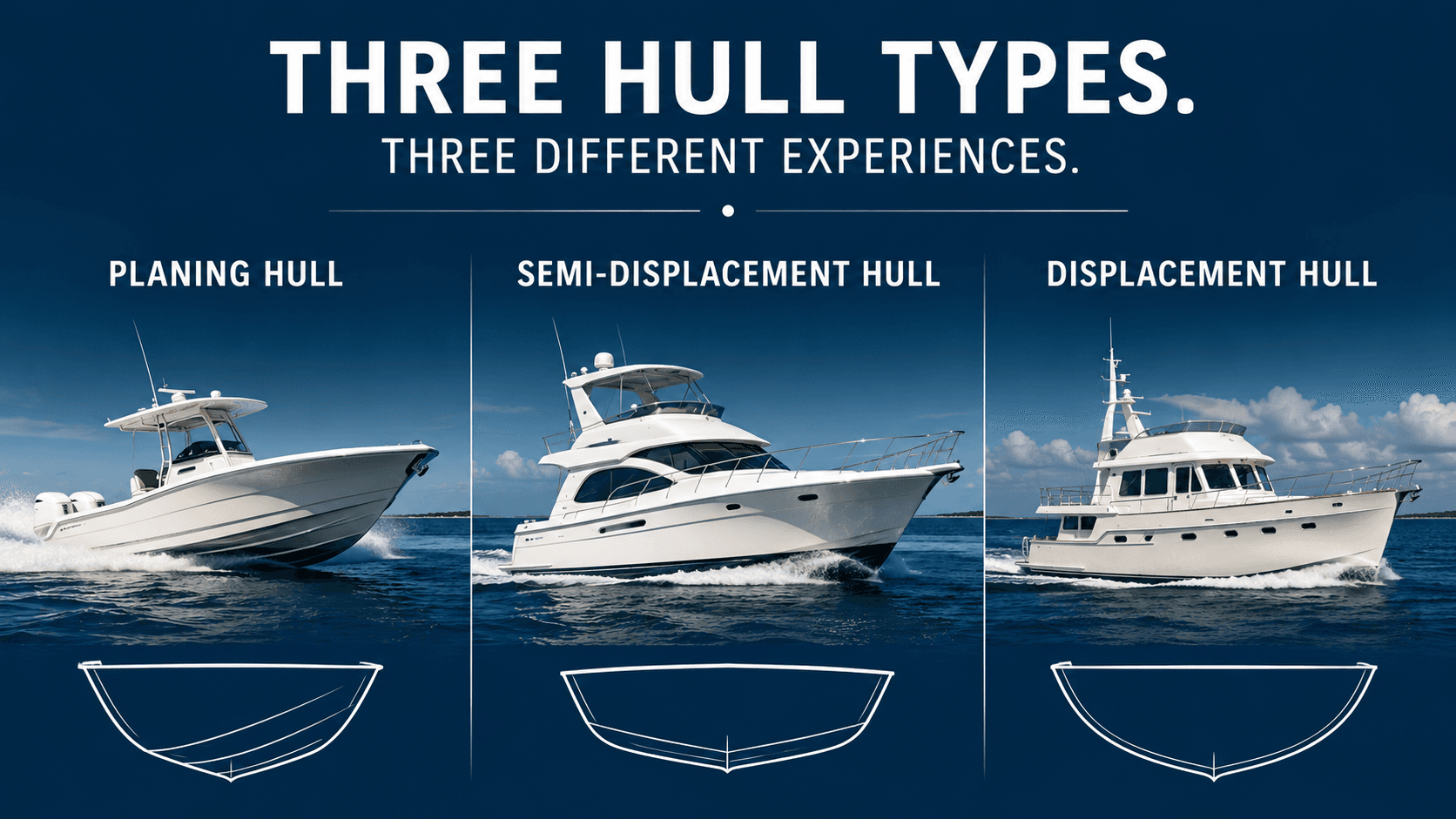
When shopping for a powerboat, there are countless things to consider. Size, layout, engine type, range, accommodations, and price all matter. But one of the most important decisions is often underneath the boat: the hull design.
The hull determines how a boat interacts with the water. It affects speed, fuel consumption, ride comfort, handling, draft, cruising range, and even the type of boating a vessel is best suited for.
Three common hull categories you'll encounter when shopping for a powerboat are planing, semi-displacement, and displacement hulls.
While each has its strengths and weaknesses, there is no single "best" hull design. The right choice depends on how you plan to use your boat.
Are you looking for speed and excitement? A planing hull may be the right fit.
Do you want a comfortable cruiser that can cover distance while still offering reasonable speed? A semi-displacement hull may be worth considering.
Are long-range cruising, efficiency, and carrying capacity your priorities? A displacement hull could be the better choice.
Let's take a closer look at how these three hull types work and what you should consider before buying.
What Is a Planing Hull?
A planing hull is designed to rise up and ride on top of the water as the boat gains speed.
At slow speeds, a planing boat behaves much like a displacement boat, pushing water aside as it moves forward. As speed increases, however, the hull generates lift. Eventually, much of the hull rises out of the water, reducing the amount of surface in contact with the water.
This is called getting on plane.
According to Discover Boating, many planing boats reach a planing attitude at roughly 15–16 mph, although the exact speed varies significantly depending on the boat's design, weight, engine, and conditions.
Advantages of Planing Hulls
The biggest advantage is simple: speed.
Planing boats can travel significantly faster than traditional displacement boats of similar size. That makes them popular for day boating, fishing, watersports, entertaining, and getting to your destination quickly.
Other advantages can include:
Higher cruising and top speeds
Fast acceleration
Responsive handling
Large selection of boat styles
Excellent options for day boating
Good fit for watersports and fishing
Planing hulls are found on everything from center consoles and sportfishing boats to express cruisers and larger motor yachts.
Disadvantages of Planing Hulls
Speed comes with trade-offs.
A planing boat generally requires a larger engine to achieve and maintain planing speed. More horsepower also means more fuel consumption when compared with a displacement boat traveling at a slower speed.
Ride quality can also vary considerably between planing hull designs.
For example, a deep-V planing hull can provide a smoother ride through choppy water, but it may require more power and can have more draft than a flatter hull. Discover Boating notes that deep-V hulls are designed to cut through waves more effectively, while flatter hulls can offer greater stability in calm conditions and require less power to plane.
Who Is a Planing Hull Best For?
A planing hull can be a great choice if you:
Want to travel quickly
Enjoy day boating
Fish coastal or offshore waters
Participate in watersports
Frequently travel shorter distances
Want a boat with responsive handling
Don't mind higher fuel consumption for speed
If your idea of a great boating day involves getting there fast, a planing hull deserves serious consideration.
What Is a Semi-Displacement Hull?
A semi-displacement hull sits between the two extremes.
It combines characteristics of displacement and planing designs. Rather than fully lifting onto a plane like a high-speed planing boat, a semi-displacement hull uses a combination of buoyancy and hydrodynamic lift as speed increases.
Discover Boating describes semi-displacement hulls as having characteristics that allow them to achieve some planing behavior while retaining features associated with displacement designs. They are commonly found on larger cruising motor yachts.
Think of a semi-displacement hull as a compromise between speed and efficiency.
Advantages of Semi-Displacement Hulls
One of the biggest benefits is versatility.
A semi-displacement boat can provide more speed than a traditional displacement vessel while still offering many of the characteristics that make displacement boats attractive to cruisers.
Depending on the design, you may get:
More cruising speed than a displacement hull
Good long-distance cruising capability
Comfortable accommodations
Significant storage and tankage
Reasonable efficiency at moderate speeds
A good balance between speed and range
This makes semi-displacement designs popular among boaters who want to cruise rather than simply run from point A to point B.
Disadvantages of Semi-Displacement Hulls
The compromise is that you may not get the best of either extreme.
A semi-displacement boat generally won't match a true planing hull for speed. At the same time, it may not achieve the same efficiency and range as a true displacement boat operating at its ideal cruising speed.
The hull can also require substantial horsepower to achieve higher speeds.
This is why it's important to look beyond the hull label when shopping. Two boats may both be described as semi-displacement but have very different performance characteristics.
Who Is a Semi-Displacement Hull Best For?
A semi-displacement hull may be a good fit if you:
Want a comfortable cruising boat
Plan to travel moderate distances
Want more speed than a trawler
Value interior volume and storage
Cruise both inland and coastal waters
Want a versatile motor yacht
Don't need high-speed performance
For many cruising families, semi-displacement boats offer an appealing middle ground.
What Is a Displacement Hull?
A displacement hull is designed to move through the water rather than climb on top of it.
Instead of relying primarily on hydrodynamic lift to increase speed, the hull remains largely immersed in the water as it moves forward.
Traditional trawlers, many larger ships, and some cruising boats use displacement hull designs. Discover Boating notes that displacement hulls are generally slower but can provide steady performance and carry significant loads with relatively modest propulsion.
This design is particularly attractive to boaters who prioritize range, efficiency, and comfortable cruising over speed.
Advantages of Displacement Hulls
The biggest advantage is efficiency at lower cruising speeds.
Because a displacement hull doesn't need to climb onto plane, it can be powered by a relatively modest engine. This can make it particularly appealing for long-distance cruising.
Other advantages include:
Excellent cruising range
Efficient operation at displacement speeds
Strong load-carrying ability
Smaller engine requirements
Excellent long-distance cruising capability
Comfortable, steady cruising characteristics
For a couple planning an extended coastal cruise or a long-distance passagemaking adventure, these characteristics can be extremely valuable.
Disadvantages of Displacement Hulls
The biggest drawback is speed.
A displacement hull is not designed to dramatically increase its speed by climbing onto plane. As a result, cruising speeds are generally much lower than those of planing boats.
That may not matter if you enjoy the journey as much as the destination.
But if you frequently need to cover large distances quickly, a displacement boat may become frustrating.
Another consideration is that some displacement boats can have deeper drafts, depending on their hull and keel design. That can limit access to shallow anchorages.
Who Is a Displacement Hull Best For?
A displacement hull may be ideal if you:
Prioritize fuel efficiency
Plan extended cruising
Want maximum range
Don't need high speeds
Carry significant equipment or supplies
Enjoy slow-paced cruising
Plan to spend extended periods aboard
If your dream is to leave the dock for weeks or months at a time, a displacement hull may be worth a close look.
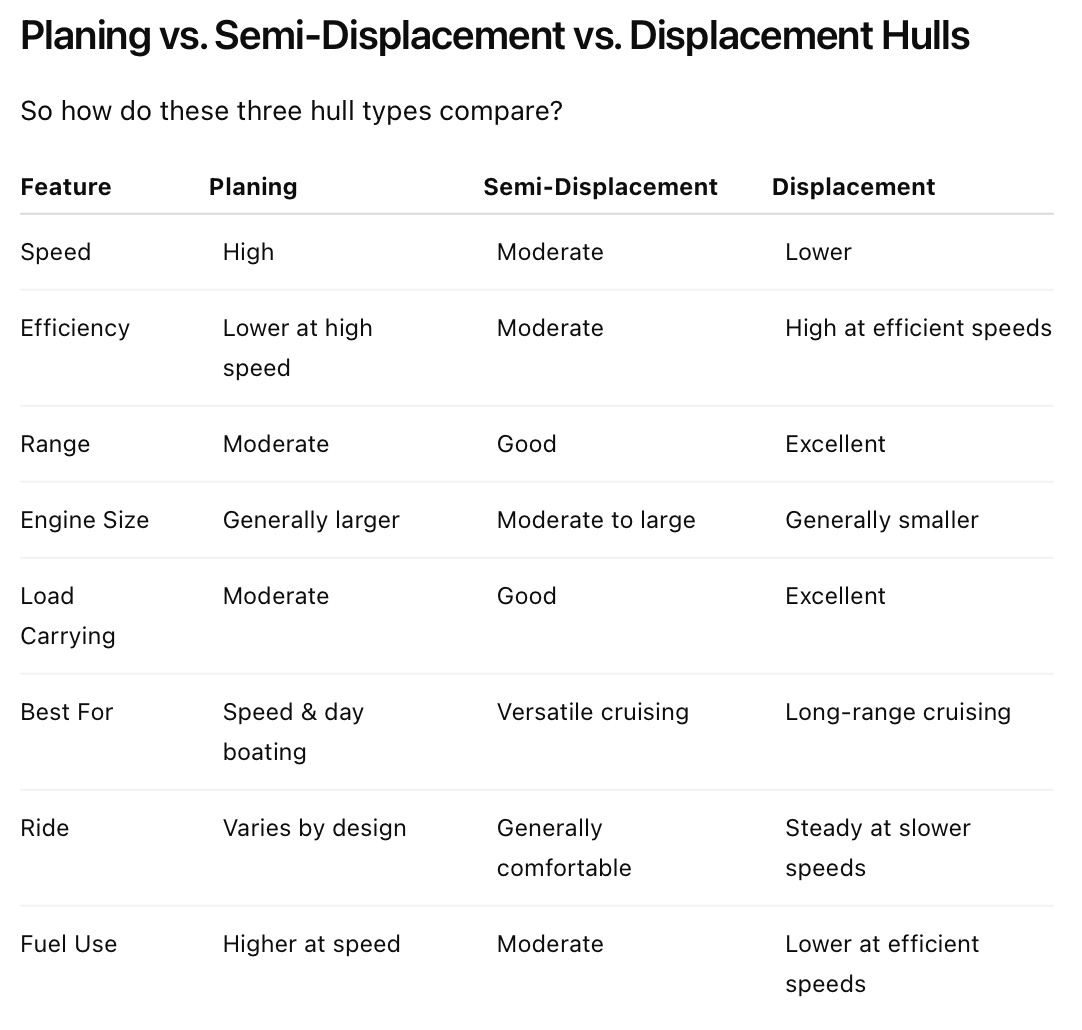
Of course, these are general characteristics. Hull shape, boat weight, engine configuration, propeller selection, sea conditions, and overall design can dramatically affect the real-world performance of any particular boat.
Which Hull Is Most Fuel Efficient?
If fuel efficiency is your primary concern, a displacement hull is generally the strongest choice when operated at its efficient cruising speed.
But there is an important distinction:
The most fuel-efficient boat isn't necessarily the boat that uses the least fuel per hour.
A boat that burns more fuel per hour but travels twice as fast may cover a given distance in less time. That's why buyers should consider fuel consumption in terms of distance traveled, not just gallons per hour.
Your intended cruising speed and the distances you plan to travel are much more important than simply looking at engine size.
Which Hull Is Best for Long-Distance Cruising?
For serious long-distance cruising, displacement and semi-displacement hulls are often strong choices.
A displacement boat can offer excellent range and efficiency at lower speeds. A semi-displacement boat can provide additional speed while still maintaining many of the characteristics that make cruising vessels practical for extended trips.
But the hull is only one piece of the puzzle.
When evaluating a cruising boat, also consider:
Fuel capacity
Water capacity
Engine reliability
Electrical systems
Storage
Generator or alternative power
Navigation equipment
Seakeeping ability
Maintenance requirements
Interior accommodations
Safety equipment
A boat with excellent range isn't very useful if it doesn't have the accommodations or systems needed for the way you intend to cruise.
Which Hull Has the Best Ride?
This is where things get more complicated.
There isn't one hull type that automatically provides the best ride in every condition.
A planing boat with a well-designed deep-V hull can provide an excellent ride at speed in rougher conditions. A displacement boat can offer a steady, predictable motion at slower speeds. Semi-displacement designs attempt to balance several characteristics.
The best choice depends on where and how you boat.
If most of your boating is on protected waters, your priorities may be very different from someone crossing open coastal waters.
And remember that speed itself affects comfort. Traveling through rough seas at 25 knots is a very different experience than traveling through the same conditions at 8 knots.
How Should You Choose Your Hull Type?
Instead of asking, "Which hull is best?", ask:
"Which hull is best for the way I want to use my boat?"
Start by thinking about your typical boating day.
If You Want Speed
Look closely at planing hulls.
They're a natural choice for boaters who want to get places quickly, enjoy watersports, fish, or simply enjoy the performance of a fast powerboat.
If You Want Versatility
Consider a semi-displacement design.
It can provide a useful balance between cruising comfort, range, and speed.
If You Want Range
A displacement hull may be the better fit.
If you're more interested in watching the coastline pass by than racing toward it, the efficiency and long-range capabilities of a displacement design can be hard to beat.
Don't Choose a Hull Based on Numbers Alone
It's easy to get caught up in horsepower, top speed, fuel capacity, and range numbers when shopping for a boat.
Those numbers matter, but they don't tell the whole story.
The same hull type can behave very differently depending on the boat's overall design. Weight, length, beam, hull shape, engine placement, propeller selection, loading, and sea conditions all influence performance.
Even how you load the boat matters. BoatUS notes that improper weight distribution can affect handling, comfort, and a boat's ability to get onto plane.
That's why a sea trial is so valuable when purchasing a boat.
You want to experience how the boat accelerates, cruises, turns, handles waves, and feels at the speeds you expect to use.
The Bottom Line
Planing, semi-displacement, and displacement hulls are designed around different priorities.
Planing hulls are built with speed and performance in mind.
Semi-displacement hulls offer a balance between speed, comfort, and cruising capability.
Displacement hulls prioritize efficiency, range, and steady long-distance cruising.
None is automatically better than the others.
The right hull depends on your destination, cruising style, budget, desired speed, and how you expect to use your boat.
The best boat isn't necessarily the fastest boat or the most efficient boat. It's the boat that fits your adventure.
FAQ
What is the difference between a planing and displacement hull?
A planing hull is designed to generate lift and ride on top of the water at higher speeds. A displacement hull remains largely immersed and moves through the water rather than riding on top of it.
Is a displacement hull more fuel efficient?
Generally, yes, when operated at its intended cruising speed. Displacement hulls can travel efficiently at lower speeds without requiring the large amount of power needed to push a boat onto plane.
Are semi-displacement boats good for cruising?
Yes. Semi-displacement designs can provide a useful combination of cruising comfort, range, and speed, making them popular for a variety of cruising applications.
Which hull type is fastest?
Planing hulls are generally the fastest of the three. They are specifically designed to generate lift and reduce the amount of hull in the water as speed increases.
Which hull type is best for offshore cruising?
There is no universal answer. Semi-displacement and displacement designs are often well suited to long-distance cruising, but the boat's complete design, construction, systems, range, and intended operating conditions are equally important.
Can a displacement boat plane?
A traditional displacement hull is not designed to plane. Some boats fall into the semi-displacement or semi-planing category and can develop some hydrodynamic lift at higher speeds, but they should not be confused with true planing designs.
Conclusion
Choosing between a planing, semi-displacement, and displacement hull ultimately comes down to how you want to spend your time on the water.
If speed is the priority, a planing boat may be the right answer. If you're looking for a balance between performance and cruising, a semi-displacement boat could be a better fit. And if your goal is to travel farther while enjoying efficient, comfortable cruising, a displacement hull deserves serious consideration.
Before making a decision, think beyond the boat's top speed or engine size. Consider where you will cruise, how far you want to travel, how many people will be aboard, how much gear you need to carry, and what kind of experience you want along the way.
The right hull isn't about choosing the "best" design. It's about choosing the design that best supports your adventure.
Ready to find the right powerboat for your next adventure?
The team at Adventure Yacht Sales can help you understand the differences between boat designs and identify vessels that fit your cruising goals, experience level, and budget. Whether you're looking for a fast planing boat, a versatile semi-displacement cruiser, or a long-range displacement yacht, having knowledgeable guidance can make the buying process easier.
Ready to start your search? Contact Adventure Yacht Sales and let us help you find the boat that's right for your adventure.